Friday, October 07, 2005

What was I thinking?

This year, like every one of the past 15 years, I vowed I wouldn't acquire any plants for which I didn't have specific plans. To qualify the plan is supposed to be more specific than "It's pretty and I don't have one yet."

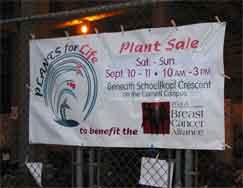
This year, like every other, I failed. But this year I failed spectacularly. It started small with a dozen perennials from a local half-price sale. Then it was a few shrubs that I felt sorry for at Agway 'cause they were so neglected I was pretty sure they'd die. This started a major downslide into late summer sales and Plants for Life bargains culminating with nearly 100 free plants salvaged from Plants for Life overstock after the sale.

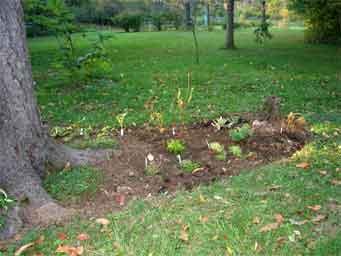
Consequently, I've spent the past four days furiously clearing new areas and planting. This new area includes Alchemilla, dianthus, Geum and Lychnis. It will be backed by junipers and barberry that I hope will be relatively resistant to deer damage.


In desperation, with rain forecast, I sank about 30 plants in vegetable bed that had already been cleared for next year. I promise I'll plant them next spring before the space is needed for vegetables.

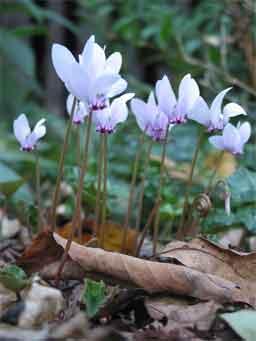
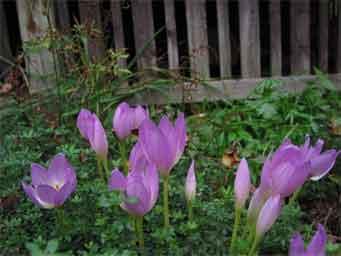
Oh, yeah. I forgot to mention the 200 bulbs Bill bought for me. Including more of these lovely Cyclamen hederifolium, which is blooming now in the border under the west living room window.

I'm exhausted and thankfully, it's raining today. I have to get groceries and I should be working on the framing for Bill's show that's opening Thursday - oh, and the Dryden Town budget workshop at 4:00.

Wednesday, October 05, 2005

Peaceful Coexistence

When Tang drinks from the goldfish tub, the fish come up to greet him. Sometimes the big one seems to nibble on Tang's tongue.

Tuesday, October 04, 2005

Bill

Bill's been cleaning his room. We won't talk about how long it's been since he last cleaned it, but he found his World War II helmet. This inspired an afternoon of stories about his years in Burma and India during the war. He became a reconnaissance photographer because of the years he worked at Kodak trying to save enough money to go to Cornell. He wrangled an assignment in Asia 'cause, as a biologist, he thought it would be more interesting than Europe. And it was.

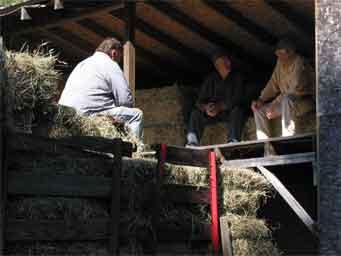
Yesterday Clinton Cornell and his father, Clinton Cornell Sr, delivered hay. I took a break from loading it into the loft to go get a jug of water. When I came back this is what I found. Clinton Sr is about Bill's age and they reminisced about storing loose hay on their family farms in the 20's and 30's.


They got back to work. I helped - honestly - when I wasn't taking pictures. We chatted after the hay was stored. Clinton Sr mentioned that he has a bulldozer. I jumped on the info with "Do you build ponds?" And, yes! He loves to build ponds. We walked over to the area where I've long dreamed of having a pond. He agrees it would be a great site. He said he wishes he'd know a few weeks ago - this dry season would have been ideal for digging. But I'm excited! We'll definitely do it next summer.

Dryden Democrats

To see a bit about local politics in Dryden, New York, visit our new blog.

Sunday, October 02, 2005

Big things

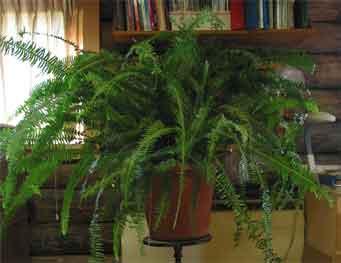
Greg asked me to take in his Boston Fern because he doesn't have room for it. I didn't really grasp what that meant when I agreed to take it. It's three feet high and four feet wide!

Belinda bought a cauliflower for dinner. It was nearly a foot wide and weighed more than five pounds. Setting aside what we wanted for dinner, I froze five packages for delicious future dinners.

Saturday, October 01, 2005

Fringed Gentian


Cornell maintains a natural area about a mile from my house primarily to encourage the Fringed Gentians that grow there. It's amazing! Thousands of intense blue flowers in a meadow of an acre or so.

Friday, September 30, 2005

Energy Use

Hey, look. The US is not the biggest, baddest energy consumer in the world. According to Natural Resources Canada (scroll down to figure 6) the US is the third largest energy consumer per capita and the seventh largest as a percentage of GDP. On the other hand, we're a long way from the best. Thanks to Benj Hellie at For the Record.

Technology

Technology is, well, you know, a mixed blessing. It takes me a long time to learn the many useful features of some of the devices in my life. I master the reason I bought the device right away. Then over the next few months - or years - I discover other wonderful things the device can do. I don't know how to check my message machine from another phone. I never seem to need to do that. I don't know how to put my cell phone on speaker - though that seems like it would be useful. I admit, I don't know how to tape a TV show.

But I've just discovered the min/max feature of my electronic thermometer. My house has no north-facing windows. It's been challenging to place an outdoor thermometer where I can see it but it's not affected too much by the sun. Last Christmas I received this electronic thermometer with a remote sensor (and a clock continually updated by the national atomic clock!) So, I put the remote sensor in the shade of the north side of the house and - voila - I've got a good idea what the outside temperature is.

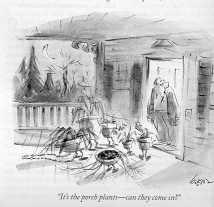
It also records the minimum and maximum temperatures. If I reset it at regular intervals I guess I could know the daily minimum and maximum temperatures. I don't need to know that everyday. But last night someone at the Dryden Democrats meeting said a hard frost was forecast. Damn! My houseplants are still outside. I had reset the min/max setting last week when I discovered it. So, checking this morning, I see that the lowest temperature since then was 41. And porch plants are happily safe.

Tuesday, September 27, 2005

We love math

Only at my favorite economics blog could people get excited enough about how teachers are learning to teach division of fractions to post 42 comments in the first 17 hours following the appearance of the article - including one at 4:30AM! And come up with so maybe ways to look at 1/4 divided by 2/3. I love it.

Arghhhh! How did I forget to watch The West Wing Sunday night? Damn. And how did I forget that my sun roof was open when it rained - twice!? And how did I forget that my credit card payment was due day before yesterday? Damn. Some days my life just gets out of control. But I can divide 1/4 by 2/3 and I can enjoy reading about it. Life is good.

Monday, September 26, 2005

Pretty good news

Mother Earth News this month features an excellent article on Fuel Economy and Ecology: Green Means Go. I'm happy to say that Jane, my manual transmission Toyota Corolla, purchased 5 years ago, still ranks highest in mpg of all cars except hybrids. She also ranks very low for air pollution and greenhouse gases. Add to that the fact that I only drive about 5,000 miles a year and I'm pretty proud of plain Jane. If I can get in the habit of checking tire pressure, I'll be able to move on to other energy conservation issues in my life.

Tiny energy tip

Somewhere recently I read that good iced coffee is made with cold water - like sunshine tea. I've been drinking room temp coffee for 25 years - ever since toddlers taught me that you can't finish a cup of coffee while it's hot anyway. My coffee maker is 1025W - yikes. I make coffee for myself about 3 times a week. If I remember to turn the coffeemaker off when it's ready so it doesn't stay on "keep warm" that's about 39 hours a year or 40 KWh - $5.29 a year at my exorbitant electricity rate.

Anyway, it turns out coffee made with cold water is good - and easy. Draw your own conclusions.

Sunday, September 25, 2005

Web Search - Gerin Oil

Some days web searches are just too weird and compelling. I started out this morning (after the usual Brad DeLong and Science and Politics) at The Literary Saloon. From there I clicked on this link to a Prospect article on "the world's top 100 public intellectuals." Checking out the Prospect's main page I found this Richard Dawkins article: Opiate of the masses. Who could resist?

You have to read it to appreciate it. But in case you don't have time, the gist is this: Gerin Oil (or Geriniol) is a powerful, addictive, widely used drug which induces delusions leading to things like the 9/11 hijackings and the Salem witch trials and most of Europe's wars in the Middle Ages. Do I have your attention yet? Are you wondering, as I did, why you've never heard of it?

My Google search for Geriniol led only to quotes from Dawkins article but Google suggested I might have meant Geraniol. It's hard to imagine Dawkins making that kind of spelling error, but I took the bait and read several interesting articles about Geraniol, a natural essential oil found in thyme, hops, beebalm and other herbs and widely used in perfume and aromatherapy. Incidentally, did you know there a section of SciWeb where you can find abstracts of chemical and medical patent applications?

However, I was on the wrong track. I switched to searching for Gerin Oil. Check it for yourself if you've got time for a laugh. But it turns out that Gerin Oil and Geriniol are anagrams for religion. Now go back and read the Dawkins article, "Opiate of the Masses."

Wednesday, September 21, 2005

Liberal Liberty?

Sometimes I'm so naive I just amaze myself. I've been happily reading Brad DeLong for months and learning a lot about economics. This morning after checking Brad and Big Brass Blog and Science and Politics, as usual, I came to Environmental Economics which I found last weekend and posted on the sidebar here. EE has just posted the results of a reader survey showing that readers perceive the site to be just a tiny bit left of center. This will tell you more about the readers than the site in just a minute.

The first link under Env-Blogroll is A Better Earth. Okay, I should have been clued in by the subtitle "alternative approaches to environmental concerns." Perhaps even more so by the acknowledgement at the bottom of the page:

"aBetterEarth.Org is a project of the Institute for Humane Studies at George Mason University, a non-profit educational organization that promotes innovative thinking about how we can achieve a world that is peaceful, prosperous and free."

But I was sidetracked by the link near the bottom of the left-hand sidebar to the "Bunny Game." It's been a while since I've played an online game and I thought maybe this would be educational. And it was - though not so much in the way it was intended.

The game "tragedy of the bunnies" demonstrates (in the "public" version) that 30 bunnies are wiped out almost immediately by the greed of the three stakeholders. The "private" version goes on to demonstrate that if each of the three stakeholders is given ownership of 10 bunnies the population can be sustained - much to the advantage of everyone. The game went on to explain to me "The Tragedy of the Commons"

" ... a well-known phenomenon to environmentalists and economists. The phrase itself was penned by Garrett Hardin in his seminal 1968 article, "The Tragedy of the Commons."

As any economist will tell you, people respond to incentives. If there's a valuable resource lying about in a commons (picture a pizza at a frat party) people will try and grab as much of that resource as they can before the resource is depleted. This response is natural; it's an example of people responding to incentives. In other words, in a zero-sum game, you need to "get while the getting is good". The more other people get, the less there is for you.

Even if the resource is renewable (like a forest or an elephant population) the situation can turn into a zero-sum game. This is because while it may be in the community's interest to refrain from depleting the resource, it's still in each individual's interest to "get while the getting is good." Tragically, the very people who do act in the long-term public interest and refrain from depleting the resource end up getting nothing. Even more tragically, when a renewable resource is utterly depleted, no one benefits over the long-term. This is the tragedy of the commons."


Astonished by the one-sidedness of this explanation I followed a sponsor link to Institute for Humane Studies (I hesitate to provide links to all these places - suffice it to say the subtitle of this site is "Explore the ideas of Liberty...") and from there to LibertyGuide.com. (by now I'm getting the hang of interpreting sites with "Liberty" in the title) and from there to this article referring to "the tragedy of the commons."

Hmm... the author is a professor at Berkeley. Let's see if there's any connection to Brad DeLong. I search the site for Brad DeLong and get 167 hits, all of which, apparently, are about how wrong he is. Wouldn't I love to be a fly on the wall at those faculty meetings.

All this led me to a long investigation of the meanings of liberal and conservative (more on that tomorrow). And another in a long line of fruitless efforts to substantiate my sense that Democrats are smarter than Republicans. The only shred of evidence I've ever turned up is the oft-repeated data from the National Opinion Research Center at University of Chicago, General Social Survey, which shows Republicans have about half a year more formal education. Yet the fear of universities as dens of liberal iniquity persists. I'm confused.

Tuesday, September 20, 2005

Reading

In How To Be Alone, Jonathan Franzen includes the insightful essay, "Imperial Bedroom" addressing the issue of "Privacy, privacy, the new American obsession..." Franzen describes privacy as a kind of two-way street. There's the conventional mode of your own private information being made public - dangerous when a stranger gains your credit card information or embarrassing when people you know see you going into a sex toy store. And there's the opposite intrusion when other people's private actions are thrust in your face - like the salacious details of Clinton's indiscretion in the Times at your breakfast table or the construction worker peeing on the sidewalk.

I'm grappling with the distinction between privacy and anonymity. Franzen describes the 19th century small town where everyone knew each other and observed every movement of each neighbor. I grew up in a 20th century town almost like that. Compare that to Wegman's tracking my shopping habits. They know my every grocery purchase for the last 15 years. But they don't know me, so I don't really care. It's a far cry from the corner druggist, whom I'd see at church on Sunday, knowing I was buying condoms - not that that could have happened when I was a teenager in this small catholic town in the sixties.

But we all deal with privacy and anonymity on the internet. I feel fairly private at home. I live alone. I don't always lock the doors. I don't always close the drapes (details I probably shouldn't reveal). Still, at home I feel comfortable doing pretty much as I like. But I know that a hundred yards away, on the road, I should have clothes on and I should probably refrain from singing and dancing. I know there are things I can say and do in private that would be too much trouble to deal with in public.

Under the heading of "caring what other people think," I used to teach my kids that if they're doing something that they'd have to lie about if questioned, they should examine the possibility that they're doing something wrong. I still think it's a good rule. Ask yourself, "Could I stand up in public and defend this action?"

"Online privacy?" Isn't that an oxymoron? Don't we all know, by now, that the internet is public? There's a certain risk in revealing private information online - whether it's your encrypted credit card account number or the blog details of why you hate your boss. As Franzen points out, "When Americans do genuinely sacrifice privacy... they do so for tangible gains in health or safety or efficiency. " For example, airport security and department store surveillance cameras.

Still, in some areas, like heath and legal records, I understand why privacy is important. There's still a great deal of prejudice against people with certain health problems or arrest records. And there are plenty of things that are simply no one else's business.

P.S. I like that spellcheck wants to make "Wegman's" either hegemonic or awesomeness.

Monday, September 19, 2005

Energy usage

Working on my "Top Ten Things to Save The World" list. Using less household energy is somewhere on the list - I don't know just where yet. But I did a quick check on the EnergyStar site. They think I'm doing better than 75% of households. In the process I found my electricity/propane bills have declined 28% in two years. That's good news. I can probably do better with caulking leaks and adding insulation. I definitely have to figure out the water heater question.

Soon I'll look at less packaging and local food. Then I'll move on to things in the community.

Birds

I don't see how I can carry binoculars all the time, but it's so frustrating not to have them when I see something unusual. Just now when I went out to hang up the laundry, two birds took off from the poplar tree at the edge of the yard. My first impression was "very big raptors." But I don't think raptors should make so much noise taking off. The poplar tree would be a great outlook over the adjoining field of overgrown scotch pine, blow down and sapling hardwoods. They're definitely raptor shape. They circled overhead for several minutes 'til I decided to go get binoculars. I swear it only took a few seconds. But when I came back I couldn't find them. After a few minutes I saw them circling, maybe 1/4 to 1/2 mile east. The more I think of the choices, the more I doubt everything I thought I saw. I'd say they were bigger than red-tailed hawks (not to mention - no red tail). I would have said the size of a raven but light colored. I give up.

Sunday, September 18, 2005

Garden


One of the joys of living in one place for a long time is that eventually the gardens pay off. There are lots of Colchicums blooming in my garden right now.

And this worked out pretty well in the "Blue and White" garden.

For the record, the morning glories grew in the shade of a black walnut tree - hardly ideal. And with fairly diligent application of deer repellant the 'Casa Blanca' lilies did well.

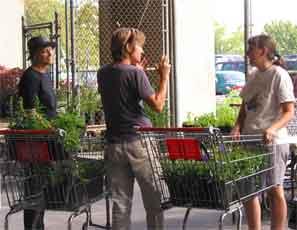
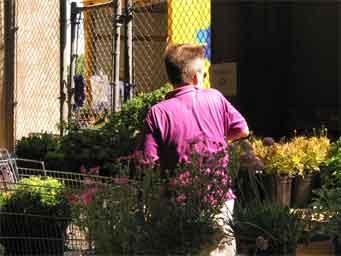
The Plants for Life sale went well last weekend. Here we are setting up. Truckloads of beautifully grown plants.


Couldn't resist buying some things. Then Sunday, when I went back to help clean up, volunteers were encouraged to take home certain kinds of plants that will not be grown on for next year. I can't believe I ended up with 76 shrubs and perennials, including the ones I bought. I've been all week trying to get them planted. About 15 to go and I need to remove some sod to make room for them.

Saturday, September 17, 2005

Priorities

If I were to list, in true 7-Habits fashion, things most important to me, numbers 1, 2 and 3 would be "learning." But for numbers 2 and 3 learning would be tied environmental protection. The obvious way to go would be with learning about environmental protection.

This blog has been pretty random. My environmental interest doesn't show up when I'm also involved in learning more about economics, philosophy, politics, photography, gardening, etc., etc.

This morning I've been pursuing the elusive perfect environmental site. What I usually want to know is "What shall I do next?" and "Why?" I already reduce, reuse, recycle, compost, own a high mileage car, keep my thermostat low in winter and more. So, superficial conservation tips aren't very helpful. But I've found a few sites that I plan to keep an eye on.

For news and links: Gristmill, Alternative Energy, Triplepundit.

Two sites stand out. Enviropundit, for good writing and design. And Environment Economics for a "stand back and look at the big picture" perspective.

Friday, September 16, 2005

Constitution

Today is Constitution Day - the anniversary of the ratification of the constitution. Thanks to Senator Byrd's amendment to a 2004 spending bill "every school and college receiving federal money must teach about the Constitution on Sept. 17..." C-SPAN is asking callers questions from a multiple choice quiz. I can't find a link to the quiz, but among the questions I remember are :
  • How many states must ratify an amendment? (majority, 2/3, 3/4 or all)
  • Which state first ratified the constitution?
  • Who was the first Vice President?
  • Which right is guaranteed to a person accused of a crime? (1. to hear witnesses against him, to have any judge he chooses, to change the location of the trial, another choice I can't remember)

It's discouraging how many callers are answering wrong. One caller made an interesting point. On this topic there's none of the usual vitriolic arguing among callers. Everyone likes the constitution - which is amazing considering how little callers seem to know about it.

Some of the questions on C-SPAN are the same as this quiz on the Whitehouse Kids page. There's also this Constitutional Timeline at the National Constitution Center. Very cool site. Check it out. Do it now. There will be a quiz tomorrow.

Sunday, September 11, 2005

Reading


I wish there were an easier way to update the sidebar. I imagine there is. But for now I'm stuck with editing the template which I don't enjoy so I don't do it very often. Still, these two books are worth noting. Things Fall Apart is my bookclub's current choice and the community reading project for Cornell and Ithaca. Birdsong, by Don Stap, is a great study of "our enduring fascination with birdsong, from ancient pictographs and early Greek soothsayers, who knew that bird calls represented the voices of the gods, to the story of Mozart's pet starling." (from the dustcover)