Monday, November 06, 2006

New Kitty

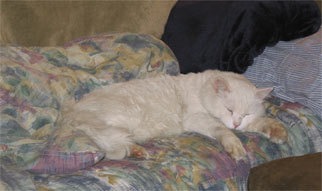
We have a new cat from the SPCA. Doesn't he look right at home? It hasn't really been that easy. He and Tang and Magda spent a couple of days creeping around sizing each other up.

They seemed to have it worked out. So, the next lovely sunny day, when I knew I was going to be around the kitchen most of the day, I boldly let all three of them go out. They all promptly disappeared under the porch. An hour later Tang and Magda came back without the new cat. I'm thinking, "Oh, great. They've led him into the woods Hansel and Gretel style." And I started looking for him.

When I still couldn't find him at dusk I was pretty frantic. Shortly after dark, Belinda spied him with a flashlight, sitting calmly about a hundred feet away at the edge of the woods. I tried to circle around him so that when I got closer to him he wouldn't panic and run toward the road. But still no luck. He fled into the woods.

We returned to the house to regroup. I couldn't think what to do. But I left the kitchen door open and fretted. I think it always helps to worry. Maybe a half hour later Belinda said, "Don't move!" Of course, I moved. But just a tiny bit - enough to see him sneaking cautiously into the kitchen. Whew. I slammed the door.
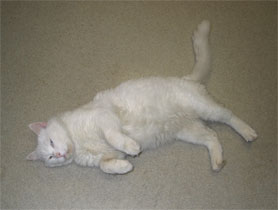
He started whirling on the floor and purring ever so loudly and quickly ate up his supper.

There's a longer, more harrowing story about the second time I let him out. But suffice it to say I won't be letting him out again any time soon.


Here's one of the most special things about him. Look at those eyes.

Maggy called him White Cat, which we shortened to WC. But when you say it out loud, of course, it isn't shorter at all. So we settled on Winston. WC - Winston Churchill. Get it?

Sunday, November 05, 2006

Change of Season

The barn is clean, the chicken house is clean, half the garden is cleaned up and spread with manure for a headstart next spring. I've fed the bees and spread more than half the mulch that was delivered last month. Most of the fruit trees and shrubs are protected from deer browsing. One and a half cords of wood are in the shed (another cord to go.) Jelly and jam are in the cellar and carrots and onions are stored.

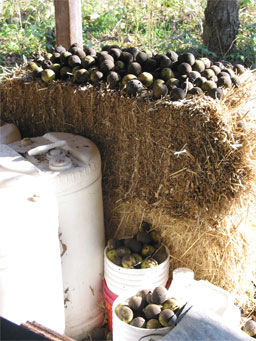
Still I'm absolutely nowhere compared to this red squirrel. He's intent on filling up the maple sugar house with black walnuts. He's covered the woodpile, filled every stray concrete block and syrup bucket.

He's run out of nooks and crannies and taken to simply piling them up wherever he can.

I particularly like this batch on the roof. What made him think that would work?

Seriously, don't ever be tempted to plant a black walnut in your yard. My yard came with them and I've adapted. But I'd never choose it.

Besides the fact that the roots exude a hormone that's toxic to many plants that you might want to include in your landscape, every season brings it's own particular black walnut mess. In the spring I'm still cleaning up the remains of the previous year's crop. In early summer the flowers drop and cover the sidewalk and the deck. In the fall, between the underfoot giant ball bearing effect and the nuts falling overhead, it's worth your life to walk through the yard. They drop their leaves practically all in one day after the first frost and the petioles, the little stems of the compound leaves, persist throughout the winter to be cleared away in the spring. And as if you weren't tired of them already, you find them germinating everywhere a squirrel stored them and didn't come back for them.

On the plus side, they are beautiful. And I have eaten the nuts and used the husks to dye wool yarn. I've been forced to cut a few and gotten some beautiful lumber from the logs (which is good 'cause they're terrible as firewood.)

Friday, October 27, 2006

Barack Obama

This morning Washington Journal referred to the Time cover article on Barack Obama and asked "Should Obama run for president in 2008?" Most people calling in said they didn't know enough about him even to have an opinion on whether or not he should run - several people even slamming the media for making a big deal about Obama when nobody's heard of him. I have to wonder why someone would call in to a talk show just to say how completely ignorant they are. But let's set that aside for a moment.

You've already heard me making a big deal about Obama and slamming the media for ignoring him. So as you can imagine, I'm please with the recent flood of coverage following the release of his book, The Audacity of Hope. If you know people who need some help getting to know Obama, try Americans For Democratic Action. Their 2005 scorecard evaluates voting records on twenty issues important to Democrats last year. Obama, along with twenty one other senators including Clinton and Schumer, voted for Democratic values on all these issues. The League of Conservation Voters ranks Obama 100% on seven key votes in 2006. The National Education Association gives Obama an A on 14 key votes in 2005 and 2006. Obama's Senate website and his professional website both include links to many of his speeches (but not the Iowa speech that so impressed me.)

Should Obama run for president? That's really not the most important question. Just listen to him. If you can't remember what the Democratic Party is about, if you have trouble explaining the Democratic Party to your relatives around the Thanksgiving table, if you're tired of hearing "Democrats don't have a plan," listen to Obama and follow the link on his website to Do More Than Vote.

[Cross-posted at Dryden Democrats]

Wednesday, October 18, 2006

Gates and Buffett

PBS aired a very funny and uplifting hour long program, "Buffett And Gates Go Back To School." The two business superpowers answered questions from students at University of Nebraska at Lincoln College of Business Administration. (A couple of the students identified themselves as "Actuarial Science" majors. Who knew that was a major at any school?)

Buffett and Gates hesitated on the question "If you could have one superpower, what would you choose?" Maybe they've never encountered this icebreaker popular with college students. Gates answer was not "flying" or "invisibility" but "reading super fast." Buffett agreed saying he figures he's wasted ten years by reading slowly. I've long envied Maggy's super fast reading ability - a talent she seems to have inherited from her father. They both tend to read novels in just a couple of hours. I used to think they couldn't really be absorbing what they read. But I was wrong.

One of Maggy's favorite children's books is "Petunia," the story of a goose who finds a book and carries it around the barnyard feeling superior 'til she learns it's not enough to own the book - she has to be able to read it.

What I'm leading up to is that I came home from the Friends of the Library booksale yesterday with another dozen books.


My new choices in fiction:
Choices by Mary Lee Settle - "A narrative borne on the exhilarating currents of memory, Choices is the story of a courageous woman who puts compassion ahead of society's expectations of her."
Anywhere But Here, Mona Simpson - "a moving, often comic portrait of wise child Ann August and her mother, Adele, a larger-than-life American dreamer."
Clearcut, Nina Shengold - "Set in the gloriously rugged backwoods of the Pacific Northwest in the 1970s, Nina Shengold's gripping debut novel follows three people in search of new lives deep into uncharted terrain of the body and heart."
The God of Small Things, Arundhati Roy - "Roy writes with extraordinary grace, creating a world so vivid and strangely beautiful that reading it is akin to entering a mirage."

And essays:
Adventures in Contentment, David Grayson - "...the Grayson stories shed light on the attempts of middle-class Americans to rethink gender norms during the progressive era"
The Merry Recluse, Caroline Knapp - ""A potent blend of the very serious and the highly comical."
Our Land, Ourselves, Peter Forbes, editor - "...a new way of viewing land conservation as the process of building values and positively shaping human lives. "
In Deep, Maxine Kumin - "From a hillside farm in New Hampshire, a talented and perceptive Pulitzer Prize-winning poet records the sprawl and benevolence of nature with intelligence, humor, and tenacity of spirit."
On the Contrary, Mary McCarthy - "The electric snap and crackle of a literate mind and pen in contact with some of the striking intellectual and social currents of our time."
Nora Ephron Collected, Nora Ephron - "As tart and refreshing as the first gin and tonic of summer."

...and a couple I won't list here in case they turn out to be Christmas gifts.

The Friends of the Library sale continues this weekend with prices from a dime to a half dollar.

Monday, October 16, 2006

Getting (and Staying) Informed


It has never been easier to learn about our elected representatives. In high school I discovered the Congressional Record - the tissue thin paper with tiny print reporting the proceedings of the Senate and House of Representatives verbatim. It was the only way to read about what was going on in Congress.

Now the Senate and the House and each and every Congressperson have their own websites. And there are non-partisan summary sites like this one powered by capwiz.com for the New York Times. There you can look up a particular legislator or piece of legislation and find a summary and links to further information. You can even sign up for email notification of upcoming votes and your legislators' records. I've added the "Write Congress" button site to my sidebar.

I was on this site tonight to look up Olympia Snowe. Ronni Bennett at Time Goes By, on a "vote the bums out" rant today, said:
Find out who the incumbent running in your district is and vote against him or her. It doesn’t matter if the other candidate is a Republican or a Democrat. They are all the same these days. (Remember the corruption voters rebelled against when they took the Congressional majority away from the Democrats in 1994.)

They are most definitely not all the same. Ronni lives in Maine where the Seantor up for re-election is Olympia Snowe. I don't always agree with Snowe (I don't always agree with anyone.) But she is one of perhaps only two Republicans I would seriously consider voting for and she's definitely what Ronni Bennett is looking for:
...the candidate who comes closest to speaking with honesty, will be accountable for his/her actions and has an idea or two that can move the country forward.

So, under the heading of "Be careful what you wish for," check it out.

Sunday, October 15, 2006

Wegmans vs. Whole Foods

Just as I appreciate Simon for pointing me to Ithaca Journal articles I might be missing, I'm glad I have Maggy to scan the New York Times for me. Among our favorite entertainments, when Maggy's here in Ithaca, is browsing in Wegmans. And when I'm in New York, chances are we'll shop in Whole Foods for dinner ingredients. So, this NYT Style article comparing Wegmans and Whole Foods is a natural interest for us.

The Samurai Shopper is more put off by the "stink of Zen" than I am. There are those here in Ithaca who think Wegmans is too tree-hugger or granola-head and would be appalled by Whole Foods. But the culture of both Wegmans and Whole Foods suits me pretty well. Selection in Wegmans is much wider than Whole Foods, perhaps because of the physical size of the stores. Prices in Wegmans are more reasonable, partly because of the wide range of selection. This summer Wegmans made a greater effort to stock local produce. It will never compete with the Ithaca Farmers' Market on this score, but checking labels reveals a fair number of local products year round.

But the clincher for me has always been service. The only eyebrow raising service I've ever encountered was the checkout clerk sobbing into her tissue as she passed my groceries over the scanner, because she'd just seen her boyfriend checking out with another girl. Otherwise, when I ask a clerk where to find something, they walk with me to where the item should be located. If it's missing from its spot on the shelf, they go to the warehouse to find it. Most clerks make pretty good small talk. They all seem to be happy with their jobs and proud of the store. It's no wonder Wegmans is repeatedly recognized as one of the best employers in the nation.

Thursday, October 12, 2006

International Crane Foundation

I had the great pleasure, last night, of hearing Dr George Archibald at the Lab of Ornithology. George was a student of Bill Dilger's and over the years I've heard many stories about him. Bill's very proud of having contributed in whatever small way to George's incredible ability to change the world.

George's life includes an number of examples of chance favoring the prepared mind. In 1967, already accepted to medical school in Canada, he hitchhiked from Montreal to Ithaca to visit the Ornithology Lab. There entirely by chance he met Dr Dilger and after an hour chatting about cranes, Bill asked, "Why don't you come to Cornell to study them?"

Working in New York, George overheard a conversation in the hall outside his office including references to Aldo Leopold and Wisconsin. There he met Ron Sauey, coincidently a student of Dr Dilger’s whom George had not yet met in Ithaca. Ron’s family farm is a few miles from Leopold’s homestead in Wisconsin. George and Ron became friends and in 1973 co-founders of the International Crane Foundation in Baraboo, Wisconsin.

Getting his PhD may have taken George longer than usual because he kept pausing to save bits of the world. In 1972, he was studying Red-crowned Cranes in Japan. This flock, which winters at feeding stations, was thought to breed in Siberia. When George found that the flock was nesting in a marsh on the north end of Hokkaido and that the area was scheduled for development he launched a public awareness campaign to save the wetlands.

In 1973 George traveled to Australia to rescue captured six Sarus Cranes in Australia and brought them to Wisconsin for captive breeding. The Eastern Sarus Crane, nearly extinct in 1973 is now being reintroduced in Thailand. In the mid-1970s, living in the Korean DMZ and studying white-naped cranes, Archibald spotted four Crested Ibis. Having received permission to take them to Wisconsin to attempt captive breeding, George spent several very cold winters in Korea in a vain effort to capture them. Later, as the Bamboo Curtain lifted, two breeding pairs were located in China leading to a successful captive breeding program.

Not the least of the accomplishments of the International Crane Foundation is the captive breeding and reintroduction of Whooping Cranes, one of two North American Crane species. George achieved media notoriety courting Tex for several years. Tex had been hand-raised and was imprinted on humans. George's courtship dancing made her hormonally receptive to artificial insemination and eventually led to the hatching of her only offspring Gee Whiz.

Researchers at ICF pioneered hand-raising techniques which avoid imprinting the chicks and enable the young birds to be reintroduced to the wild. Finally, ICF has established Crane School where young Whooping Cranes learn to fly with an ultra-light. Eventually the cranes are able to migrate with the ultra-light to wintering grounds in Florida. The current ultra-light led Whooping Crane migration began last week. You can follow it's progress here.

George Archibald is the 2006 recipient of the Indianapolis Prize. designed "to be a great, enthusiastic, spectacular celebration of victories. ... to inspire the general public to start caring in a way they’ve never cared before, and to place heroes who often live in tents, in danger from both wild beasts and human enemies, on the same pedestal that we usually reserve for sports and entertainment stars.” I'm proud to count George Archibald among my heroes.

Wednesday, October 11, 2006

Reducing Carbon Dioxide Emissions

Maggy sent me a link to Andrew Postman's article "The Energy Diet." Don't know how soon it will disappear behind the pay-wall so take a look. It's a light hearted narrative describing Postman's motivation, after seeing An Inconvenient Truth, to do something - anything - to help. He rushed out to buy 50 compact fluorescent light bulbs. (Yes, some people have asked why he has 50 lights to put them in.) But he found he didn't like the color of the light from them, so he stashed them in the basement and brooded over his guilt.

Weeks later, after hearing about President Clinton's Global Initiative, Mayor Bloomberg's plans for an Office of Long-Term Planning and Sustainability and California's legislation to reduce greenhouse gas emissions, Postman conceived the Energy Diet. He knew, from having taken the “Calculate Your Impact” survey on climatecrisis.net, that his household produced nearly 20,000 pounds of carbon dioxide - nearly 5,000 pounds more than average. With the help of information from thegreenguide.com, stopglobalwarming.org and the Natural Resources Defense Council Postman set about trimming his household energy use to achieve a 25% reduction in production of carbon dioxide. He found several simple ideas he could use - involving practically no sacrifice at all. Rinsing laundry in cold water, getting off the mailing list of several catalog companies, putting his computer and entertainment electronics on power strips to save the energy they use in standby mode.

Will this save the world? Probably not. But Postman learned at least one important thing:
“It’s all about attitude,” said Laurie David, the founder of the Stop Global Warming Web site (stopglobalwarming.org) and a board member of the Natural Resources Defense Council. “Change one or two things, you end up changing four or five things. You can’t put the toothpaste back in the tube. Before you know it, you start influencing people around you.”

Tuesday, October 10, 2006

Website Advertising

I have honestly never before clicked on an ad on any website. But I couldn't resist this one this morning. Why Mommy Is a Democrat.
In the true spirit of Heather Has Two Mommies here's a child's eye view of a political issue. From my adult viewpoint, this is really amusing - the nurturing, protective mommy squirrel making sure "we all share our toys" and "children can go to school." I want someone to write the counterpart: Why Daddy Is a Republican.

But the thought of reading this to a toddler feels pretty sleezy. While Heather Has Two Mommies and books like it are about breaking down stereotypes, Why Mommy Is a Democrat is all about stereotypes. I think it's a great idea to teach children - and adults - about Democratic values. But I'm pretty tired of the black hat/white hat view of the world.

Still, I want this book for Christmas. No, wait. Wouldn't it look great in Maggy's stocking?

Sunday, October 08, 2006

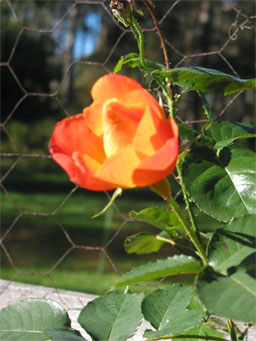
Last Rose of Summer

That sounds so sad. I'm trying, in vain, to think of a silver lining...

Thursday, October 05, 2006

Poem on My Desktop

Early in this blogging project I wrote about a poem I cherish: "reprimand" by Dick Lourie. I wrote not that I like the poem, which I do, but I like the actual printed copy I have of it which continues to remind me of the friend who sent it to me.

I was reminded of it this morning reading Poem in my Pocket by Endment and her link to "The Unwritten" by W.S. Merwin.

Wednesday, October 04, 2006

Photojournalism

I knew when I saw this photo of Fran Townsend, White House advisor on homeland security, a reference to her diminutive stature couldn't be far behind. I mean, look at those shoes. Look at the photographer's perspective on them. Why would a person working in the White House wear shoes like that? Sure enough. Third paragraph. Townsend is 5 feet tall. And for some reason, it's important that we know that.

Perhaps even more surprising to me is that apparently Maggy's right about stockings. (Maybe that's really where the photographer's gaze is focused.) Call me old fashioned, but I thought women in professional positions who wear dresses, also wore stockings.

Community Science Institute

Last night I went to a presentation by the Community Science Institute. (At the moment their old website, featuring contact information and a "Welcome" link, is still up. But I hope by the time you're reading this the new one they were demonstrating last night, with links to each watershed feeding the southern end of Cayuga Lake, will be up.)

CSI coordinates an extensive volunteer effort to test and monitor water quality of Virgil Creek, Fall Creek, Six Mile Creek, Taughannock Creek, Trumansburg Creek, Salmon Creek and the Cayuga Inlet. About eight times a year, volunteers measure temperature, pH and dissolved oxygen, phosphate and nitrate levels at several specific points on each creek. Water samples are submitted to CSI's certified professional lab for verification and analysis of additional parameters including E. Coli, Phosphorus and Nitrate.

In addition to water sampling, which provides a snapshot of a specific moment in the life of the creek, once a year volunteers sample Benthic macroinvertebrates (BMI) present in stream water. BMI are collected and identified to order and family and compared to a model developed by the Department of Environmental Conservation. Each type of BMI is sensitive to different characteristics of water quality. So analysis of the number of each type of BMI reveals a useful picture of the water quality over the recent past history of the creek.

In the past government agencies have not used data collected by volunteers because the accuracy of the data was not verifiable. CSI has developed "simple yet effective protocols for volunteers that were field-tested and shown to assure data quality when they were applied consistently." Extensive volunteer training as well as independent verification by CSI's lab have resulted in a high degree of confidence in the data.

Data collected over the past few years show streams in the Cayuga Lake watershed to be healthy. Scored on a ten point scale, local streams score around 7.5 - about what would be expected on a body of water with a moderate amount of human activity around it. As executive director, Stephen Penningroth, put it, Six Mile Creek is "not wilderness, but it's not New Jersey either."

Community water quality testing often only begins when there is a known problem. This project provides useful data on a healthy watershed. In addition, it provides baseline data for the Lake Cayuga watershed so that problems can be recognized as they begin to develop and mitigated in the early stages. Finally, extensive involvement of community volunteers helps educate the public and encourages residents to get to know their streams, develop a sense of protectiveness and take pride in their quality.

[Cross posted at Dryden Democrats.]

Tuesday, October 03, 2006

Cornell University Press

Belinda brought me the Cornell University Press catalog yesterday. I didn't expect the catalog itself to be so interesting. I was surprised to find two books I've read (Revolt on the Tigris and Third-Sector Development) that I didn't know were published at Cornell.

Some titles are pretty far down my list of "Things I want to read" like The Vanishing Hectare. The title has possibilities, but the subtitle... Well, judge for yourself.

And there are some that I'll probably never understand, like Reason and the Heart. Again, the title is great. But when the subtitle has two words I can barely pronounce and have little chance of defining even if you make it multiple choice, well, I won't be running out for that book today.

But there are lots I'd like to read. How about The Field Guide to Bacteria? Or Front-Page Girls about women journalists around the turn of the 20th century? Or Visions of Belonging: New England Art and the Making of American Identity. How about this, or this, or this which I'd buy for the cover design alone.

But I really can't afford them. And the library doesn't have them. I know the public library budget is limited and facing further cuts. Maybe the publisher could donate...

Monday, October 02, 2006

Mulch

I have a huge pile of woodchips in the driveway and a dozen mulching projects to tackle. The project yesterday was to mulch the fruit trees.


I wanted to pull up the landscape fabric we used under the mulch when we planted the trees 'cause it made the clay soil look like this.


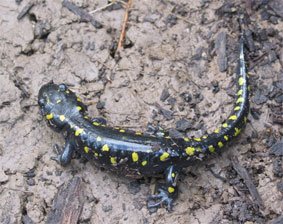
In the process, we found this spotted salamander under the fabric. He's a bit slow moving 'cause the weather is cool. Bill tells me his bright colors show that he's young. Both the black and the yellow will fade next year.

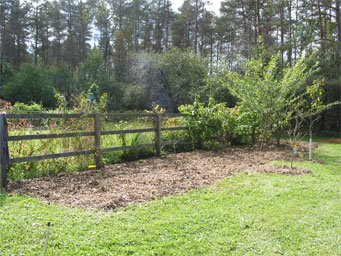
At the end of the day (by the way, this is the only context in which that phrase should be used) the fruit garden looked like this. The generous layer of woodchips will begin adding its micronutrients to the soil and decomposing to improve soil texture.

Sunday, October 01, 2006

Bees!

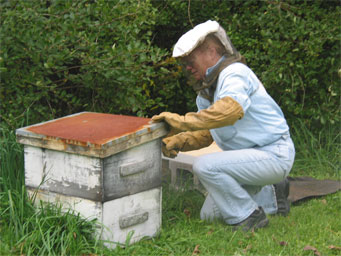
Last spring I was thinking of reviving my beehives, but the cost of packaged bees made me think twice. So, in June when I heard a swarm in the air, I scrounged up some old beehive parts and hurriedly put them near where the swarm was scouting. I knew that the bottom board I'd found in my rush was deteriorating. And, still in a hurry, I put the hive directly on the ground instead of on a hive stand.

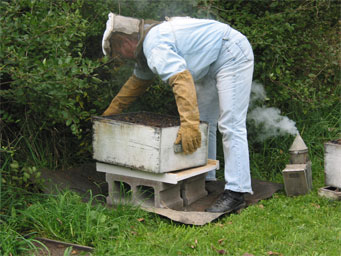
Still, happily, the swarm did choose my hive. All summer the bees struggled with the grass growing in front of the hive and I procrastinated about fixing it. Now, with (dare I say it) winter approaching, I wanted to see if the bees have enough honey to survive and to get the hive up off the ground to give them a chance in the snow.

Good thing I checked. They've barely started filling the top super, which should be full before winter if they are to make it through.

If this super were full, it would weigh about 45 pounds. So I move them one at a time.

Knowing that the top super isn't full yet, I can provide some diluted honey for them. They will store and evaporate it just like they do with nectar. So, although we will not get any honey from them this season, I have high hopes that they'll be in good shape to start working early next spring.

Folklore has it that "A swarm in May is worth a load of hay. A swarm in June is worth a silver spoon. A swarm in July isn't worth a fly." The idea is that a swarm in May will have time to get established and possibly provide surplus honey for the beekeeper. A swarm in July won't have time to get settled enough to survive the winter. This swarm was in June. I'm never sure whether a load of hay is worth more than a silver spoon. But these bees, with a little care and luck, will be worth at least the $70 that packaged bees cost.

Saturday, September 30, 2006

I and the Bird

I'm very excited. I've agreed to host I and the Bird #37 on November 30. I'm a bit intimidated. I've contributed a couple of times to IATB. But generally it seems the participants are better or more serious birders and bloggers than I have been lately.

Mike's first tip for hosts is "Sign up." Done. His second tip is "Tidy the place up!" Okay. I really need to do that.

And the third tip is "Recruit." I admit when I considered doing this I thought the entries would just come. And they probably will. But in addition, I want to encourage birder friends to plan to send entries directly to me in time for my deadline - probably 11/28. Of course, the earlier you send them, the easier it will be for me.

In the meantime, take a look at the current I and the Bird at Don't Mess With Taxes. [Check the I and the Bird page for an index to earlier issues.] And don't miss I and the Bird #34 October 12 with Pam at Tortoise Trail; I and the Bird #35 October 23 with Dan at Migrations; and I and the Bird #36 November 9 with Roger at Words & Pictures.

Friday, September 29, 2006

Friday *** Blogging

Much as I love the concept of Friday Cat Blogging, I also really look forward to Science Friday every week. Here's just one random thought about how people perceive science.

The writer of a letter to the editor in Mother Earth News this month wrote:
I am not going to support major policy initiatives that involve huge expenditures of funds and resources on a problem based on a scare, when the science is still suspect at the very best. Most, if not all, that is being observed can be attributed to the natural warming and cooling cycles of the planet.
So, with consensus reached only weeks ago that, in fact, warming is occurring, we're moving on to whether or not human activity is affecting it. I'm here to say, maybe it doesn't matter so much.

While some of us focus on reducing carbon dioxide emissions, the unbelievers can focus on know problems arising from warming. Whether you believe that human activity is insignificant in causing global warming or you believe that we're past the point where we can correct the effect human actively has had on global warming, we should be looking closely on the effect global warming will have on coastal population, agriculture, extreme weather, fresh water supply and more.

Thursday, September 28, 2006

Field Trip

Yesterday was a gorgeous day for a field trip. I spend most of the day with the Town of Dryden Highway Superintendant visiting the new town hall construction site, the Virgil Creek Stabilization project and the Virgil Creek flood control dam. Complete story at Dryden Democrats.

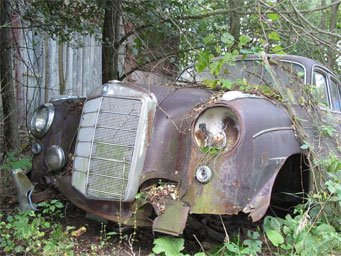
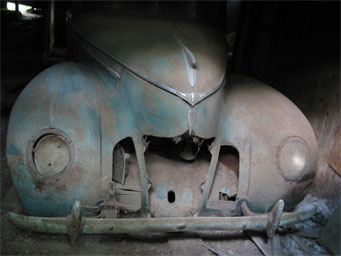
One fun unexpected detail was the discovery of this Volvo collection on the long neglected property adjacent to the new town hall site. The town purchased this property to facilitate design of access to the new town hall.

I counted seven cars, tho' I think at least one of them was not a Volvo. We're applying for a grant to restore the house and return it to residential use. Sadly, the Volvos will probably be sold for salvage.

Wednesday, September 27, 2006

Homemade Mayonnaise

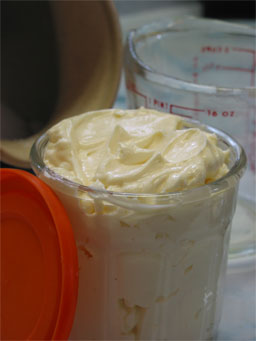
It's been a long time since I made mayonnaise at home. But now that I have fresh eggs, I'm happy to do it again. With the "stick" blender, it's easier than ever. It starts with an egg, an ounce of vinegar, a pinch of salt and ground mustard.


A few minutes of blending while drizzling in a cup and a third of vegetable oil and voila - mayonnaise.

The mayonnaise can be varied by using different oils and vinegars and one begins to understand how, in earlier times, some cooks came to be known for their skill. Homegrown eggs might be of different quality. Homegrown mustard might have a different flavor. And homemade vinegar - the possibilities are delightful.

I like the flavor of my mayonnaise. And I like that when it's gone I'll make more and refill the jar rather than throwing away (recycling) a mayonnaise jar. I don't know the environmental impact of a single mayonnaise jar but what if ten people made mayonnaise at home? Before you know it, it would be an honest to goodness Alice's Restaurant movement.