Wednesday, August 30, 2006

Cowboys

Time's cover article a few weeks ago was The End of Cowboy Diplomacy. And more recently a reader wrote to the editor to complain:
"Using the word cowboy as a term of derision is insulting to most Americans. Cowboys have always been the good guys, no matter what the European press or some folks on the East coast of the U.S. may think."
Is this the latest in PC-ness? I don't read the word "cowboy" as derisive. It has a specific meaning - a loner with a certain lack of regard for rules. American Heritage says: "An adventurous hero. A reckless person who ignores potential risks."

On the other hand, in the August 7 issue, a Time interviewer said to Willie Nelson: "The Dixie Chicks got in trouble for their views on the President, but your politics are pretty liberal too. Nelson's reply:
"I'm surprised I didn't get in trouble a year before that when I was at a press conference overseas and they were asking me about our wild Texas cowboy President. I said 'He's not from Texas and he ain't a cowboy, so let's stop trashin' Texans and cowboys."
"Wild Texas cowboy" could go either way. If you're talking about, you know, a cowboy from Texas, it sounds vaguely admiring. If you're talking about the President of the United States it would sound inappropriate except that it is an image Bush has cultivated. East coast stuffed shirt that I am, I'm glad it's being toned down.

In the meantime, I think we could be more careful with the literal meanings of words, less quick to attribute unintended judgements.

Monday, August 21, 2006

Good News, Bad News

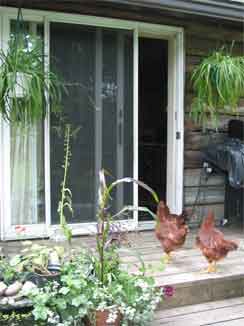
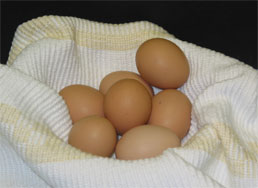
The good news is that the hens have started laying eggs. Seven lovely, tiny little eggs - one and a half ounces each.

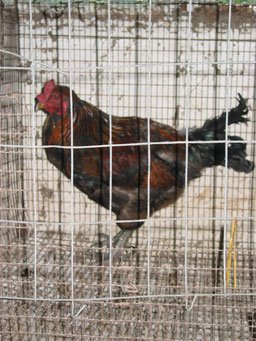
The bad news is that the evil
rooster really nailed me yesterday. I thought I was winning by keeping a sharp eye out for him but I had to laugh when I went out yesterday and realized I was sneaking out the side door, tiptoeing and looking over my shoulder. When I got home I was keeping an eye on him. He was twenty or thirty feet away as I got out of the car. Being cautious, I went around to the passenger side, putting the car between me and him. I looked away from him for a second to reach in and get my things out of the car and WHAM! He hit my shin with his spur. I'm really limping today. But wait. There's still good news. The evil rooster is now in rooster-jail.

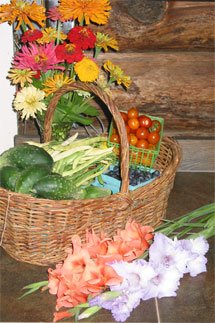
And in further good news, the garden is just bursting with goodness. Yet more blueberries - three pints. About a pound a day of pole beans. Damn, I forgot to put them in the picture and they're really gorgeous. Another quart of cherry tomatoes, half a dozen paste tomatoes and a couple of slicing tomatoes. A pile of cucumbers - I guess I'll have to make some relish. Three summer squash. I don't know what's going to become of them. And these amazing carrots. In May I saw a magazine article with a beautiful photo of various colored carrots. I was inspired and ran out to buy seed. These are, Purple Haze, Danvers and Yellowstone. I wonder if they'll taste as distinctive as they look.

Sunday, August 20, 2006

Crop Circles


This isn't a digital graphic design. It's a photograph. It's an aerial photo of Oregon farmland. I don't fly very often, but I remember being amazed by this geometric view from the air more than twenty years ago.

I found the photo on Earth & Sky's Human World page. It links to Robert Anex's description of the impact of agriculture on the earth. Anex says that while cities, roads, dams and such cover 1% of the earth total land area, cropland and pasture cover 40%. In Iowa, where Anex lives, 89% of the land surface is farmland. The impact of deforestation and increased nitrogen fixation and release of methane is undeniable. Anex says he is "cautiously optimistic that we CAN maintain agricultural production while improving the environment." I'm more cautions than optimistic.

Thursday, August 17, 2006

Harvest

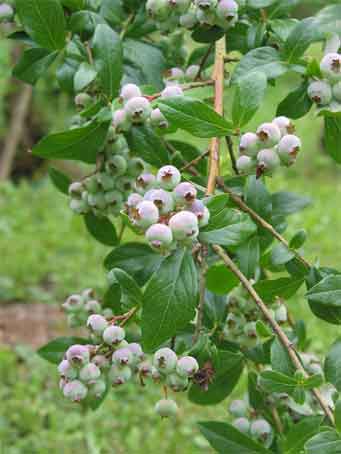
This is the really rewarding part of vegetable gardening. What you can't really see under those beans and cucumbers are three pints of blueberries. We have five bearing blueberry bushes and we've been picking blueberries for a month now. I have ten pounds in the freezer and we've had many desserts and unlimited breakfasts with blueberries. If you don't have blueberries in your garden yet, get some. If you don't have room in the vegetable garden, find a place in the landscape for them. They're very attractive shrubs - lovely in bloom and great fall color.

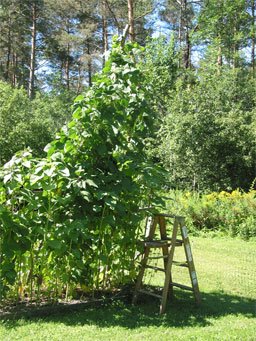
I put in these ten foot bean poles for kind of a Jack in the Beanstalk effect. I can barely reach the beans at the top even with the ladder. I garden in raised beds and pole beans rule for yield in a small space. The quantity of beans has surpassed my ability to eat them daily, so I've got to find room in the freezer for some.

For pounds per square foot, it's a close race between beans and tomatoes. I had the first tomato sandwich of the season last night. Tomato sandwiches always remind me of grad school. At lunch seminars everyone else had those pathetic sandwiches from the machines while I was slurping on these juicy, fragrant garden fresh tomato sandwiches. Here are the ripening Big Boys for sandwiches and San Marzanos for sauce. We are also growing heritage Brandywine and Oxhearts, Classica paste tomatoes, Sun Gold cherry tomatoes and Sweet Million red cherry tomatoes.

Maggy Has a Very Bad Day and Lives to Laugh About It

It's a sad day that goes by without at least one thought worth writing down. And it looks like I've had quite a few lately. But my quiet days are a blessing compared to Maggy's bad day. Note that #7 of the nine bad things that happened that day was getting hit by a cab. And it gets no more emphasis in the bad day story than the bad hair and new office phone system. At the time she didn't think she was hurt enough to see a doctor, but, of course, when her body had time to think it over it rebelled and her leg and hip are giving her a pretty bad time now.

So I was delighted to see her sense of humor return in her blog post this morning. In case you have a slow dial-up connection like mine and are not inclined to click on links, I'm going to cut and paste here 'cause this made me laugh out loud and it may brighten your day too:
"So, I had to get into work early this morning. Not too much of a problem (aside from the fact that the mouse family gets annoyed when I get up early, apparently). I throw together an outfit, I hop on the subway. I hobble to work. I greet our speakers, take them to the meeting and decide to reward myself with a super coffee from Starbucks. You know, the EXTRA caffeinated kind, because I need it.

So I order my grande iced vanilla latte, light ice, light vanilla and then I realize I can't remember how to ask for the extra shots of espresso that make it extra caffeinated.

And I say, "Also I need the thing, you know the stuff with the extra, the thing that makes it more, the caffeine is more inside, the thing that makes it more awake for me?"

I kid you not, the entire Starbucks stopped. [ed. I'm trying to imagine how loud and desperate she may have sounded at this point.] And I said "You know? The thing?" And they all laughed. I think they may actually rename the extra shot "The thing that makes it more awake for me."

The bright side of this is, I got a triple shot of espresso for free. But it's only 9 am, and I'm not sure how long that will last..."

Thursday, August 10, 2006

Prudhoe Bay

CNN reports:
Gov. Frank Murkowski imposed a state hiring freeze Wednesday because of the millions of dollars in revenue Alaska is losing as a result of the Prudhoe Bay oil field shutdown...The expected loss of 400,000 barrels per day at today's oil prices means the state is losing about $6.4 million a day in royalties and taxes...The state receives 89 percent of its income from oil revenue; Alaska has no state sales tax and no personal income tax.

This is an interesting way to have people, not just across the country, but around the world fund Alaska's infrastructure and services. Oil companies are paying $2.8 billion in royalties and taxes to Alaska which, of course, is passed on to consumers. (Incidentally, the next largest portion of Alaska's revenue is the tax on alcohol and cigarettes, followed by the tax on salmon and seafood.)

"Murkowski questioned why BP abruptly shut down the entire Prudhoe Bay field after finding a leak of only four to five barrels." The better question is why it wasn't shut down in March following a spill of 6,400 barrels (more than 200,000 gallons). Anchorage News. Quatar

According to the Alaska Department of Environmental Protection (there's an agency with a tough job) there were an average of 409 spills per year in Prudhoe Bay between 1996 and 1999. Trustees for Alaska reports that nitrogen oxide emissions from Prudhoe Bay oilfields were more than 70,000 tons in one year (June 1994 to June 1995), twice the total emitted in Washington D.C and exceeding all other Alaska sources combined by more than 20,000 tons.

I'd like to think that this evidence of destruction in Prudhoe Bay will strengthen our resolve to preserve ANWR. But I fear the shutdown in Prudhoe Bay will increase calls to open ANWR, although exploration in ANWR will do nothing to ease the crisis caused by the shutdown of Prudhoe Bay.

Monday, August 07, 2006

Iridescent Clouds

Late this afternoon, we saw this incredible cloud. The photo on the left is unedited.

Adjusting the light levels makes it look like this:

The rainbow is in the cloud.

Belinda found a name and explanation for this and another photo at NASA.
"They're called iridescent clouds. A relatively rare phenomenon known as iridescent clouds can show unusual colors vividly or a whole spectrum of colors simultaneously. These clouds are formed of small water droplets of nearly uniform size. When the Sun is in the right position and mostly hidden by thick clouds, these thinner clouds significantly diffract sunlight in a nearly coherent manner, with different colors being deflected by different amounts. Therefore, different colors will come to the observer from slightly different directions."

I don't know how you feel about it, but I don't find this explanation really helping much. I guess it's the "nearly coherent manner" that's throwing me off. Luckily the NASA site has a link to this site at the University of Wisconsin. I was a little discouraged by the introduction:
"To understand this phenomenon let's review the four basic theories of light. Each theory was derived at a different point in time and each has its advantages and disadvantages. None of the theories are completely satisfactory in that they can easily explain all the behaviors of light."

The article goes on to describe The Corpuscular Theory of Light, The Wave Theory of Light, The Electromagnetic Theory of Light and The Quantum Theory of Light. It turns out that iridescent clouds are best explained using Wave Theory. This is good 'cause it's the only one of the four that I know anything about.

I understand constructive and destructive interference, when two wave lengths are in-phase or out-of-phase. And I remember diffraction from high school physics.
"To summarize--light bends around objects (diffraction), how much it bends depends on the wavelength, white light is composed of all colors and each color has a different wavelength and therefore is diffracted by a different amount. When the light from the sun interacts with cloud droplets diffraction occurs--the light bends around the edge of the cloud droplet. Different colors are diffracted by different amounts and are therefore in-phase (and out-of-phase) at different distances from the sun. The color bands result as different colors are removed from the sun's light due to destructive interference, while other colors are enforced due to constructive interference."

So, as I understand it, diffraction (different wavelengths bending differently) makes the colors visible and constructive interference (when are in sync) makes the colors bright. I might be able to repeat this explanation tomorrow, but I hope I don't have to actually explain it to anyone.

Saturday, August 05, 2006

Friday Cat Blogging


I like to think everyone has a space in the house that is less well organized than they would like. This is one (of three) such spaces in my house - the place where I fail to file the mountains of reports I get from and for the Town Board. There's Tang in the back of the drawer that's never closed.

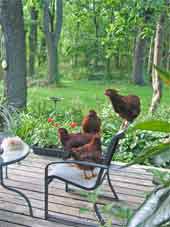
There is no Friday chicken blogging, but here they are anyway. Looks like they're waiting for the tea party to begin.

There's also no Friday garden blogging and there really should be. Here are my exuberant Glads, better this year than ever. That yellow one is over my head, as are the tomatoes in the background on the right. In fairness, I should say they have a six inch headstart in the raised beds.

Tuesday, August 01, 2006

Ask a Woman to Run for Office

When I ran for the Town Board last year, I was focused on becoming the only Democrat on the board. Halfway through the election when a newspaper reporter asked me what I thought about becoming the only woman on the Board, I was momentarily stumped. Here in the Ithaca area, we're a tad further along the road to enlightenment than some others places. Women's issues were not uppermost in my mind.

Recently Irene Stein, from the Tompkins County Democratic Committee, invited me to participate in Eleanor Roosevelt Legacy Campaign School. I felt like I'd been invited by Eleanor Roosevelt herself and I jumped at the chance. We met tonight for introductions.

The training, designed by people at Emily's List, is designed to encourage pro-choice, Democratic women to run for office and win. Emily's list was started in the 1980s at which time no Democratic woman had ever been elected to the US Senate in her own right. EVER! In fact, of 1,889 people who have served in the US Senate since its inception in 1789, only 33 are women. Of 10,546 members of the House of Representatives, 203 are women.

Why so few? According to a Brown University study (pdf) "women are significantly less likely than men to view themselves as qualified to run for office. In addition, women are less likely than men to receive encouragement to run for office from party leaders, elected officials, and political activists."

Does it matter? Well, more than half of eligible voters in the US are women. 15% of the 109th Congress are women. Let's find out if women can make a difference. People at Emily's List and the Eleanor Roosevelt Legacy Committee are working hard to recruit qualified women and support their campaigns. If you're a woman, think about running for office. If not, donate to Emily's list and ask a woman you know to run.

Seriously, find out who your local, state and national representatives are and when their terms expire. If you need help with this, email me. Find your local Democratic Committee. Go to a town board, city council, county or state legislature meeting and see what they do. It's hard work but its not rocket science. So, run! Or help someone run. Really. We need you. Get going!

(Cross posted at Dryden Democrats )

That's the way it's supposed to work.

When Wal-Mart CEO, Lee Scott, speaks people listen. From Wal-Mart Facts:
“By working together, we can help each other save money, reduce greenhouse gas emissions and pass the savings on to our customers. Sustainability is good for the environment, and it’s also good for business.”

I know. It may be a publicity thing. But I'm okay with that as long as it's producing results like this. Natural Resources Defense Council reports on Wal-Mart's plans to increase the efficiency of Wal-Mart's trucking fleet by 25 percent over the next three years and to double efficiency by 2015.
"...using more efficient tires, reducing drag by installing windshields and by narrowing the gap between cab and trailer, and offering incentives to drivers who follow fuel-saving acceleration techniques and drive at the most fuel-efficient speed (for large rigs, that's often just above 60 miles per hour). Improving Wal-Mart's fleet-wide efficiency by just a single mile per gallon could save the company $52 million a year."
Someone smarter than me can do the math and report how may gallons of diesel and tons of carbon that represents.

From the US Department of Energy: Wal-Mart Launches Second Energy-Saving Store in Colorado.
The new store, located in Aurora, Colorado, draws some of its power from a 50-kilowatt wind turbine, 134 kilowatts of solar power, and six 60-kilowatt gas-fired microturbines. The store also incorporates evaporative cooling with a low-flow displacement ventilation system. For heating, waste-oil boilers provide hot water for radiant floor heating, and a solar wall preheats ventilation air, reducing the store's use of natural gas for heating. The store's energy efficiency features include daylighting and a variety of energy-efficient electric lighting technologies.

And from Wal-Mart's own site:
"...by reducing the size of the cardboard packaging on just one line of our own-brand toys last summer, we saved more than 5,000 trees and 1,300 barrels of oil that would have gone into making the packaging."


Yes, green practices make good business sense. This is one issue where the private sector can easily get ahead of government regulation. If Wal-Mart's doing it, can others be far behind?

Monday, July 31, 2006

Eat Local Challenge

This morning's Ithaca Journal includes an article on Local Foods Week, sponsored by Cornell Cooperative Extension. Consumers are urged to spend at least $5 this week on local food. That sounds easy. Register, take the pledge and be eligible to win gift certificates from retailers and restaurants that feature items harvested from the area.

My hippie self-sufficiency urges, which were pushed to a back burner when my kids were teenagers, have been reawakening. I'm raising some chickens, re-establishing beehives, planning part of the garden more for food than flowers. But the "Eat Local Challenge" is more than the self-sufficiency movement of the 60's and 70's. It's community based. It's not only "What can I grow for myself?" But also "How can I strengthen my community?"

I used to put homegrown meals on the table more often than not. We got to be somewhat like early settlers, going to market once a month for flour, coffee and salt. It's a life changing experience: learning how to produce life's essentials. First you learn to define "essential."

But my local food skills are rusty and I'll have to start planning ahead for the Eat Local Challenge next year. Tompkins County is fortunate to have a wonderful Farmers' Market and lots of local food producers. Wegman's has a local produce display right inside the main entrance and other local products throughout the store. Not to mention Greenstar Co-op.

Check out Foodroutes and their interactive map. Type in your zip code and get a map and list of local food resources. Or Local Harvest for an interactive map of Community Supported Agriculture and other farm subscriptions.

Wednesday, July 26, 2006

2006 Elections

The New York Times offers this excellent interactive map of 2006 Senate, House and gubernatorial candidates. The map graphics can be displayed as a standard map or distorted to reflect population. Click on a state for more information.

Information on Senate races includes the amount of money raised by each candidate. For example: in Maine, Senator Snowe, $2,107,747 and challenger Jean Bright, $23,507. In New York, Senator Clinton, $27,501,536 and challenger Spencer, $1,777,748. Incidentally, the population map shows that Senator Snowe represents about 1,300,000 and Senator Clinton 19,300,000 (if I'm counting the little squares accurately.)

In the map of House races, you can click on each electoral district for, not only information about the candidates, but also demographics. My own beloved 24th congressional district in New York is listed as a "race to watch." Unfortunately no additional information is available except that incumbent Boehlert is not running. Demographics describe this district as 92% white with a median income of $36,082 compared to national median income of $44,473. Compare this to my daughter's district 15 represented by Charlie Rangel: 16% white with median income of $27,934. Or to Long Island's district 3 with 86% white population and $70,561 median income. Hmmm...

Friday, July 21, 2006

Bloggers

Slate reporter, Jack Shafer, responds to the Pew Charitable Trust survey of bloggers.
The most immediately startling for me was the repetition of the phrases "about half " or "nearly half" to describe various blogger attributes. About half of all American bloggers are men, says Pew. About half are under the age of 30. About half use a pseudonym. About half say creative self-expression or documenting personal experiences is a major reason for blogging. About half think their audience is folks they already know. Half say changing people's minds is not a major reason behind their blog, and about half had never
published before starting their blog.

This means, of course, that about half are over 30, about half are women, about half use their own names and about half say changing people's minds is a major reason for their blog. That would be my half.

Still, neither Five Wells nor my other blog, Dryden Democrats, come close to the image of "blogger" discussed in the news. We're going to need a new word soon. The A-list bloggers have readership in the thousands per day. Most are professional journalists. Most provide a vehicle for lively discussion among readers. While many write to promote their own viewpoints, hyperlinks give the reader a chance to judge the validity of the opinions touted. Many pre-blog websites were designed to provide a page of "Hey, here's something interesting I found on the web." Blogs were the natural outcome. While purely personal, or literary, or photographic blogs are also nice, weblogs remain an important shortcut to finding information on the web.

Continuing education, adult education, is highly self-directed. One reason I like National Public Radio is that I can't skip over stories with headlines that don't particularly interest me as I do with print media (including blogs.) Radio is like the required reading list of a college class. Blogs that provide "must read" links are the next best thing. The Scienceblogs site collects the best science bloggers into one easy menu. If there were similar sites for art, history, philosophy, sociology we'd be well on our way to a really powerful education system without walls.

Tuesday, July 18, 2006

Blueberries

I needn't have whined so much about winter deer damage to the blueberries. When I was pruning in March it looked like we'd get hardly any berries at all this year. But the pruning paid off and the blueberry branches are drooping with the weight of the berries. I can't see quite how that works when the buds are formed on last year's growth. I'll have to observe more carefully.

Meantime, even with the bumper crop, I've selfishly added a bird net to the top of the bushes. Sadly, a bluejay apparently got his foot caught in it and died before I noticed. I should have some kind of motion detector alarm. Or I should pay closer attention. Or I should just ditch the net and share.

Monday, July 17, 2006

Innovative Energy Solutions

During last week's rainy weather, some time I spent catching up with back issues of print magazines led me to this article in Discover Magazine. Amory Lovins, physicist, eonomist, inventor, auto designer, author and consultant, talks about energy issues. This surprising fact jumped out at me:
A modern car, after 120 years of devoted engineering effort since Gottlieb Daimler built the first gasoline-powered vehicle, uses less than 1 percent of its fuel to move the driver.

Lovins explains that only one-eighth of the energy reaches the wheels, the rest being lost in the engine, drivetrain and accessories. Of the one-eighth reaching the wheels, half is lost to friction. So, 6% of the fuel's energy is actually accelerating the car. But 95% of the mass being accelerated is the car - not the driver. The point is that if we made the car lighter, we'd use less energy getting around.

Lovins continues with some interesting information, new to me, about potential use of carbon-fiber composites and thermoplastics in auto design. This leads, Lovins believes, to lighter cars which will be safer and longer-lasting. Not incidentally, Lovins suggests that jobs will be created "partly by having a vibrantly competitive car industry rather than a failing one and partly due to the logical evolution of the auto industry toward computerization [and] the aftermarket for improved and customized software."

Lovins offers more ideas about hydrogen and electricity. On wind energy, he says:
"If I could do just one thing to solve our energy problems, I would allow energy to compete fairly at honest prices...If everything competed solely on merit, wind energy in the United States would be a lot better off. It gets subsidized less than its competitors, and its subsidies are temporary, while its competitors' are permanent."

Why aren't policy-makers thinking this way?

Sunday, July 16, 2006

Astonishing superficiality

Eleven syllables in a two word title is certainly not How to Write a Hit Article." But I share Jack Shafer's amazement at the NYT "Shamu" essay and the response to it. I'm not providing a link to the article. As a NYT "most emailed article," if it hasn't gone behind a pay wall, you can find it easily if you're so inclined. With all due respect to my daughter and my sister, both of whom emailed the link to me, don't bother looking for the article. It's a trite story of how the author applied behavior modification techniques to improve her husband's bad habits. As Shafer points out:
"The Shamu story establishes once and for all that men are the new women. You can now use the New York Times to write the most dehumanizing and insulting shit about them and everybody will laugh in recognition."

Shafer's first lesson trumps the rest:
Editors in search of page views should emulate the Times (and Slate) and pimp their headlines to attract attention. As long as the headline is half-honest, it's OK.

The Times article is headlined "What Shamu Taught Me About a Happy Marriage." Who (besides me) wouldn't want to read about that? Sadly, the article is not about Shamu or a happy marriage, making it even duller than the headline suggests.

I'm always amused by the Google search terms that lead people to this blog. I still get a surprising number of hits (anything more than one would be surprising) from searches for Skunk Cabbage. It's not just Shafer's "Lesson No. 5: Animals, animals, animals. Let me repeat: Animals, animals, animals..." My visitors are searching, not just for skunks but the total skunk cabbage concept. Runners-up in google search terms leading here are: Woodpeckers and Apricots - not among my most profound articles - and China's One Child Policy.

Monday, July 10, 2006

Fun Links

A blog without links is like, well, a day without sunshine.

Last week Maggy, whose mind may not be fully occupied by her day job, sent me this:

phrontistery FRON-tis-te-ri, n. a thinking-place.

There, Steve Chrisomalis, who writes as "Forthright," has compiled a "15,500-word dictionary of obscure and rare words," a veritable playground for those of us who've ever enjoyed the dictionary game. For example, on the same page with prhontistery: phreatic, phrenesis, phthartic, and phugoid. In addition, Chrisomalis has created thirty-two individual glosseries like: dance styles, forms of worship, units of measurement, and (probably Maggy's favorite) phobias.

Chrisomalis also presents a list of 2 and 3-Letter Scrabble Words including: AA, KA, PYA and LEU. If my opponent used those, I'd definitely challenge. And apparently I'd lose.

In Junior High english, I had to memorize a list of prepositions (about, above, along, among, around, behind, below, beneath...) and in high school I took three years of Latin, but I recognize fewer than half of these Latin adverbs and prepositions.

There's the sottisier (so-teez-YEA, n a collection of ridiculous remarks or stupidities), a collection of emails Chrisomalis has received - and presumably, not answered. And the truly hilarious Unusual Search Results which have led unsuspecting idiots to Phronistery.

Finally, check out the Language Links and The Ingenious Internet. I'm not sure I can face spell-checking this post.

Thursday, July 06, 2006

Cats and Chickens

The cats have each found their own unique way to ignore the chickens.
This is Tang, trying to stroll nonchalantly by them.

And Magda, in utter denial. "What chickens? I don't see any chickens."


I just really hope I have the camera when a chicken wakes Tang up from a nap. It's bound to happen someday.

Meantime, I've really got to remember to close the screen door. Yesterday Bill I were working in the garden and wondering why we hadn't seen the chickens in a while. The usually hang around pretty close. When we came back for cocktails, I found the chickens in the kitchen.

Wednesday, July 05, 2006

Michael's Birthday

Today is Michael's birthday. He died in 1999 when he was twenty - by far the most painful thing that has happened in my life. Someone asked this morning if I avoid reminders of him. I don't. I really can't. I think of him, roughly as if he was living on the west coast. It's just maddening that I can't call him or expect him home for the holiday. So, I offer this excerpt from Kipling's essay, Rural Funerals , again.
The sorrow for the dead is the only sorrow from which we refuse to be divorced. Every other wound we seek to heal- every other affliction to forget; but this wound we consider it a duty to keep open- this affliction we cherish and brood over in solitude.

Where is the mother who would willingly forget the infant that perished like a blossom from her arms, though every recollection is a pang?

Where is the child that would willingly forget the most tender of parents, though to remember be but to lament?

Who, even in the hour of agony, would forget the friend over whom he mourns?

….No, the love which survives the tomb is one of the noblest attributes of the soul. If it has its woes, it has likewise its delights; and when the overwhelming burst of grief … is softened away into pensive meditation on all that it was in the days of its loveliness- who would root out such a sorrow from the heart? Though it may sometimes throw a passing cloud over the bright hour of gayety, or spread a deeper sadness over the hour of gloom, yet who would exchange it even for the song of pleasure, or the burst of revelry?

Oh, the grave! – the grave!- It buries every error- covers every defect, extinguishes every resentment! From its peaceful bosom spring none but fond regrets and tender recollections.

… the grave of those we loved- what a place for meditation! There it is that we call up in long review the whole history of virtue and gentleness, and the thousand endearments lavished upon us almost unheeded in the daily intercourse of intimacy-

Ay, go to the grave of buried love, and meditate!

Then weave thy chaplet of flowers, and strew the beauties of nature about the grave; console thy broken spirit, if thou canst, with these tender, yet futile tributes of regret; but take warning by the bitterness of this thy contrite affliction over the dead, and henceforth be more faithful and affectionate in the discharge of thy duties to the living.

Thursday, June 29, 2006

More Need for Riparian Buffer Zones

Our stream joins many others here in Fall Creek where riparian buffer zones become even more important. The goal is to reduce the quantity of pollutants washed into the watershed by heavy rain such as we've had the past few days and to absorb water and reduce its speed when the body of water overruns its banks. To that end, streams are best protected by trees, with brush beyond that and meadow beyond that.